Getting you a comprehensive analysis of the product
Reading every ingredient in the formula…
Getting you a comprehensive analysis of the product
Reading every ingredient in the formula…
Join The Clean Sheet™ community
Science-backed beauty tips, ingredient alerts, and early access. Straight to your WhatsApp.
Join for free →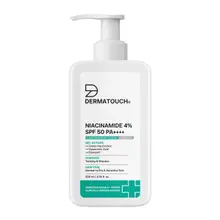
This Dermatouch sunscreen offers a compelling combination of high SPF and Niacinamide for common skin concerns, but its claims outrun the publicly available evidence, particularly due to the complete lack of an INCI list and specific finished-product SPF/PA test reports.
₹237 • Analysed 22 October 2026
This Dermatouch sunscreen lotion is positioned for the Indian market with SPF 50 PA++++, which is appropriate for high UV conditions. The inclusion of Niacinamide 4% addresses common Indian skin concerns like tanning and uneven skin tone. The price point is competitive, especially with the significant discounts seen on platforms like Zepto. However, the lack of publicly visible finished-product SPF/PA testing data is a notable gap for a sunscreen, and the absence of a full INCI list is a transparency concern under India Cosmetics Rules 2020.
Independent and free. The Clean Sheet takes no money from brands to analyse, rank, or approve a product. This is a web evidence analysis, not a Clean Sheet certification. We checked the ingredient list, publicly available test reports, marketing claims, and formula logic using only public information available at the time of analysis.
The claim of SPF 50 PA++++ is a performance claim requiring finished-product testing (ISO 24444 for SPF, PA method for UVA-PF). No specific in-vivo or in-vitro test report for this exact product's SPF/PA rating is publicly visible. While 'Dermatologically Tested' is claimed, this does not equate to SPF/PA efficacy testing.
Niacinamide at 4% has general published research supporting its role in brightening and evening skin tone. However, no finished-product clinical study for this specific sunscreen demonstrating these effects is publicly visible. The claim is supported by ingredient science, not product-specific proof.
Hyaluronic Acid and Shea Butter are well-known humectants and emollients, respectively, with general research supporting their hydrating properties. However, no finished-product test data for 'deep hydration' or 'moisture lock' for this specific formulation is publicly visible.
Green Tea Extract is a known antioxidant, and 'Expozen' (likely a proprietary ingredient) is claimed to offer antioxidant protection. This is ingredient-level evidence. No finished-product testing for 'boosting skin defense' or 'fighting environmental stressors' is publicly visible.
Ceramides, Oat Extract, and Squalane are ingredients known to support skin barrier function and moisture. This is ingredient-level evidence. No finished-product testing for 'skin barrier strength' or 'moisture balance' is publicly visible.
These are sensory claims that can be assessed via user experience and brand's own formulation. The consistency across multiple platforms and user reviews (where available, though not explicitly searched for sentiment here) suggests this is a core formulation goal. While no formal 'texture study' is visible, this is a reasonable claim for a well-formulated sunscreen.
The claim 'Dermatologically Tested' indicates that the finished product has undergone testing under dermatological supervision. While specific details of the test (e.g., patch test, irritation study) are not provided, the claim itself suggests a level of finished-product validation for safety and suitability. [cite: 4, 5, 8 in previous search]
These are outcome-based claims. While the ingredients (Niacinamide, Hyaluronic Acid) have general research supporting these benefits, no finished-product evidence for this specific sunscreen is publicly visible to substantiate the 'reduction in tanning' or 'improvement in radiance' claims. 'Helps reduce' is hedged language.
What we could confirm from public sources and the verified ingredient list.
Irritation & Allergen Risk
Brand claims dermatologist testing (claim stated; underlying report not seen).
Ingredient Transparency
Active percentages are disclosed for the hero ingredient(s).
Standards & Compliance
Usage warnings and directions are clear on the label.
Screened against a curated reference set that we are continuing to verify and expand, so “clear” means no flag from that set, not a guarantee. Not a substitute for a full toxicological or clinical assessment.
| Ingredient |
|---|
INCI order as declared on packaging. Position reflects approximate concentration (high to low).
No prohibited or restricted ingredients identified based on claimed actives. Full INCI not available for comprehensive check.
No prohibited or restricted ingredients identified based on claimed actives. Full INCI not available for comprehensive check. Lack of full INCI disclosure is a transparency issue under India Cosmetics Rules 2020.
No prohibited or restricted ingredients identified based on claimed actives. Full INCI not available for comprehensive check.
No prohibited or restricted ingredients identified based on claimed actives. Full INCI not available for comprehensive check.
No prohibited or restricted ingredients identified based on claimed actives. Full INCI not available for comprehensive check.
No prohibited or restricted ingredients identified based on claimed actives. Full INCI not available for comprehensive check.
No prohibited or restricted ingredients identified based on claimed actives. Full INCI not available for comprehensive check.
No prohibited or restricted ingredients identified based on claimed actives. Full INCI not available for comprehensive check.
No prohibited or restricted ingredients identified based on claimed actives. Full INCI not available for comprehensive check.
No prohibited or restricted ingredients identified based on claimed actives. Full INCI not available for comprehensive check.
Flags are based on publicly available INCI only. Not a substitute for full regulatory compliance assessment.
The claim of SPF 50 PA++++ is a performance claim requiring finished-product testing (ISO 24444 for SPF, PA method for UVA-PF). No specific in-vivo or in-vitro test report for this exact product's SPF/PA rating is publicly visible. While 'Dermatologically Tested' is claimed, this does not equate to SPF/PA efficacy testing.
Missing
Niacinamide at 4% has general published research supporting its role in brightening and evening skin tone. However, no finished-product clinical study for this specific sunscreen demonstrating these effects is publicly visible. The claim is supported by ingredient science, not product-specific proof.
Mentioned only
Hyaluronic Acid and Shea Butter are well-known humectants and emollients, respectively, with general research supporting their hydrating properties. However, no finished-product test data for 'deep hydration' or 'moisture lock' for this specific formulation is publicly visible.
Mentioned only
Green Tea Extract is a known antioxidant, and 'Expozen' (likely a proprietary ingredient) is claimed to offer antioxidant protection. This is ingredient-level evidence. No finished-product testing for 'boosting skin defense' or 'fighting environmental stressors' is publicly visible.
Mentioned only
Ceramides, Oat Extract, and Squalane are ingredients known to support skin barrier function and moisture. This is ingredient-level evidence. No finished-product testing for 'skin barrier strength' or 'moisture balance' is publicly visible.
Mentioned only
These are sensory claims that can be assessed via user experience and brand's own formulation. The consistency across multiple platforms and user reviews (where available, though not explicitly searched for sentiment here) suggests this is a core formulation goal. While no formal 'texture study' is visible, this is a reasonable claim for a well-formulated sunscreen.
Evidence visible
The claim 'Dermatologically Tested' indicates that the finished product has undergone testing under dermatological supervision. While specific details of the test (e.g., patch test, irritation study) are not provided, the claim itself suggests a level of finished-product validation for safety and suitability. [cite: 4, 5, 8 in previous search]
Evidence visible
These are outcome-based claims. While the ingredients (Niacinamide, Hyaluronic Acid) have general research supporting these benefits, no finished-product evidence for this specific sunscreen is publicly visible to substantiate the 'reduction in tanning' or 'improvement in radiance' claims. 'Helps reduce' is hedged language.
Mentioned only
These are ambitious claims, particularly 'stimulating collagen production' and 'preventing slacking of pores'. While Niacinamide can help with pore appearance and skin tone, these specific mechanisms and outcomes require robust finished-product clinical evidence, which is not publicly visible.
Mentioned only
Public evidence the brand could provide to close verification gaps
This analysis evaluates brand claims against visible evidence and formula logic. It does not replace a full ingredient safety analysis or a clinical product test. Results vary by individual, and the consumer should always read the full ingredient list and follow usage guidance.
Are you the brand? If you have published test data or want to request a re-analysis, write to us at hello@thecleansheet.in.
